
We are dedicated to
serving
the poor, the forgotten and the unloved.


Important Message(s)
29th Sunday of Ordinary Time

In today’s Gospel Jesus and the religious leaders in Jerusalem continue their tense exchange of questions and challenges. At this point the disciples of the Pharisees, together with the Herodians, try to entrap Jesus by their question about the payment of taxes.
Matthew sets up an unusual partnership between the Pharisees and the Herodians. The Herodians were supporters of Herod Antipas, a Jewish political leader who collaborated with the Romans. Such collaboration would have required a compromised observance of the Mosaic Law. The Pharisees, on the other hand, taught scrupulous observance of the Mosaic Law and opposed Roman occupation. Herodians favored the payment of taxes; the Pharisees opposed it. The Herodians and the Pharisees approach Jesus, asking that he take sides in their dispute. If Jesus answers with the Pharisees, he shows himself to be an enemy of Rome. If he answers with the Herodians, he offends popular Jewish religious sensibilities.
Jesus’ response to this attempt to trap him exposes the guile of his questioners. From his first words to them, Jesus shows that he is very much aware of what they are trying to do. He asks to see a Roman coin, which is readily provided to him. It may have come from the hand of a Herodian, but the Pharisees show themselves to be quite willing to accept this compromise. Jesus has already exposed the Pharisees as hypocrites.
Jesus takes his response one step further. He asks that his questioners examine the coin. Agreeing that it is Caesar’s image on the coin, Jesus tells them that it must belong to Caesar. Avoiding the question of lawfulness altogether, Jesus answers their question with simple logic. Then, going further still, Jesus tells them that their obligation is to pay to God that which belongs to God.
Jesus’ response to the Herodians and Pharisees suggests the ethic that Christians ought to adopt. It reminds us of the importance of keeping things in their proper perspective. Do we attach ourselves to worldly things at the expense of the love and honor that we owe to God?
Diocesan Support Appeal 2026
Vincentian Family News
- The Vincentian Family Daily Intention: October 21, 2026

Today, October 21, 2026, we, the members of the Vincentian Family, pray for those whose service has left them wounded.
- SVP Ireland Supports Over 2,000 Students with €3 Million for Higher Education

The Society of St. Vincent de Paul Ireland is supporting more than 2,000 students through its Education and Training Bursary Fund, with over €3 million provided for laptops, books, travel, fees, […]
- Love of God and of Other Humans

Jesus embodies love of God and of neighbor. To be true to him is to love God with all our being and our neighbor as ourselves. Love of God and neighbor comes from God’s love. For we love since […]
- Finding Courage Among the Poor: A Catechetical Journey Toward Vincentian Youth Day 2027

A new catechetical resource invites young Vincentians worldwide to prepare for Vincentian Youth Day 2027 through nine sessions exploring Vincentian spirituality, the courageous witness of the Korean […]
- Vincentian Churches Around the World 12 – Blessed Frédéric Ozanam Parish Church in Medellín, Colombia

Set on the eastern hills of Medellín, Colombia, the Parish Church of Blessed Frédéric Ozanam is a modest neighborhood sanctuary whose brick architecture reflects its surroundings. Its dedication […]
- The Vincentian Family Daily Intention: October 20, 2026

Today, October 20, 2026, we, the members of the Vincentian Family, pray for children carrying the emotional burden of caregiving.
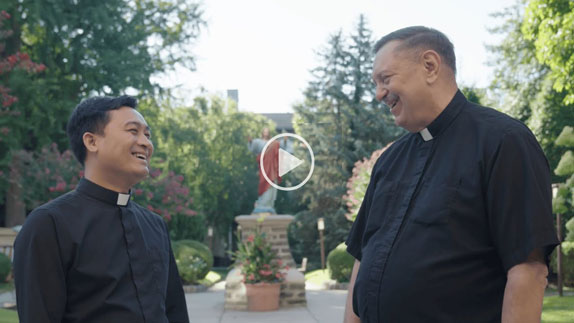
Saint Mary’s History (filmed in 2018)

400 years living the spirit of St. Vincent de Paul
Contact Information
St. Mary’s Catholic Church
812 Duke Street
Greensboro, NC 27401
Hours
Monday through Friday
9:30 AM – 2:30 PM
Phone: 336-272-8650
Email: info@stmarysgreensboro.org


© Saint Mary's Catholic Church 2026